
LangChain Integration
Drop-in callback handler for LangChain and LangChain.js. Every LLM call, tool invocation, chain step, and retrieval operation is captured as linked spans — no code restructuring.
LangChain is a framework for building LLM-powered applications — chains, agents, retrievers, and tools — available for Python and JavaScript/TypeScript.
Getting Started
Install the SDK
Install @zespan/sdk alongside the LangChain packages.
npm install @zespan/sdk @langchain/core @langchain/openaiAdd ZespanCallbackHandler
Pass ZespanCallbackHandler to any chain, agent, LLM, or retriever. No restructuring — it attaches to your existing LangChain code.
import { ZespanCallbackHandler } from '@zespan/sdk';
import { ChatOpenAI } from '@langchain/openai';
import { ConversationChain } from 'langchain/chains';

const handler = new ZespanCallbackHandler({
  apiKey: process.env.ZESPAN_API_KEY,
});

const model = new ChatOpenAI({ callbacks: [handler] });
const chain = new ConversationChain({ llm: model });

const result = await chain.invoke({ input: 'Tell me a joke' });View traces in Zespan
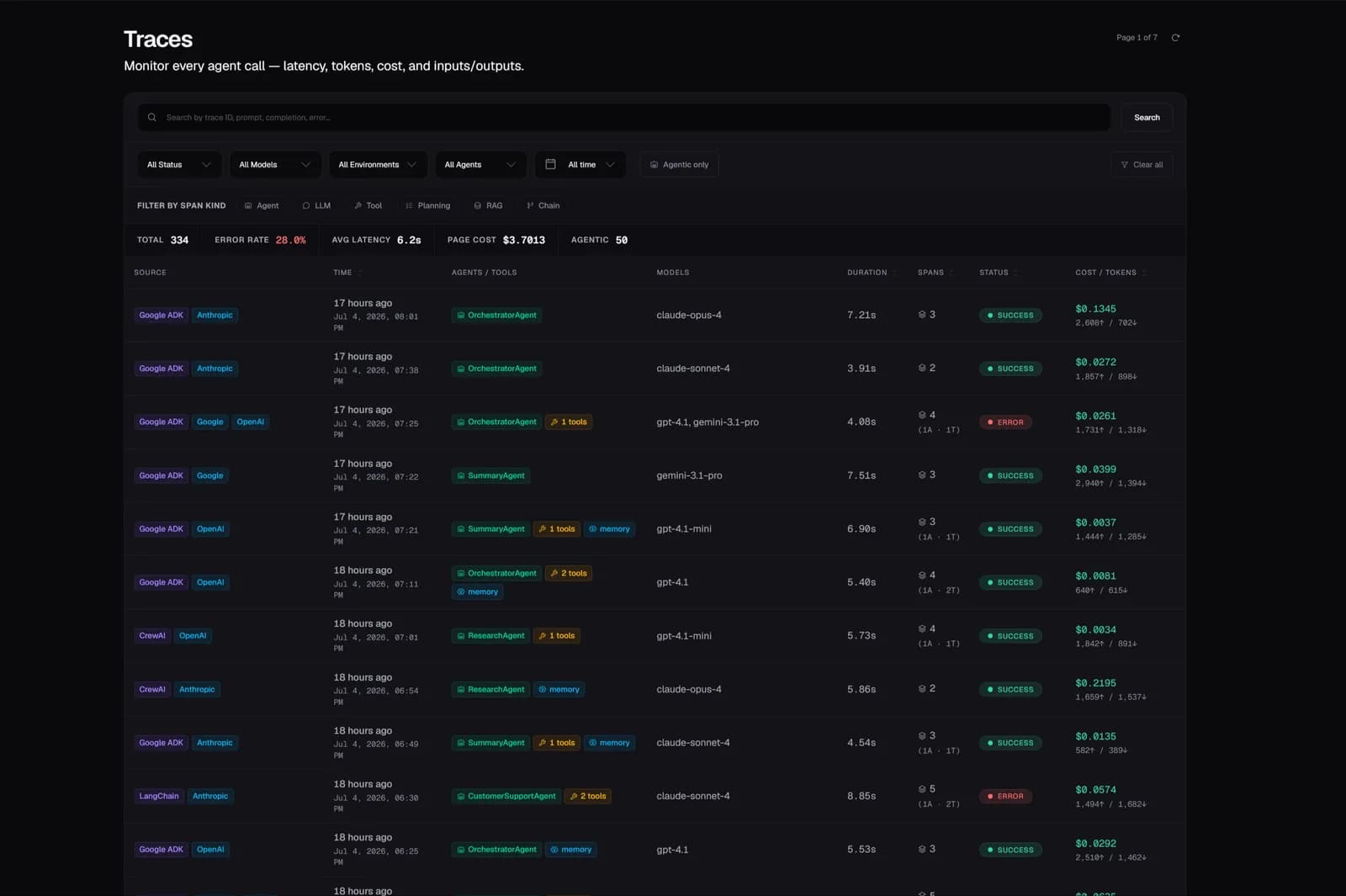
Open Trace Explorer. Each chain run appears as a trace with nested spans for every step, LLM call, and tool invocation.
What's captured automatically
- Full chain waterfall: every step, LLM call, retriever, and tool as linked spans
- Agent reasoning: thought, action, and observation per ReAct step
- Token and cost attribution: aggregated across every step in the chain
- Retrieval spans: retrieved documents, scores, and chunk counts for RAG chains
- LangGraph support: each graph node captured as a span
- Session linking: use withZespanContext to associate traces with user sessions
FAQ
Does this work with LangGraph?
Yes. ZespanCallbackHandler works with LangGraph workflows. Each node in the graph is captured as a span, and the full execution graph is visible in the trace waterfall.
Do I need to restructure my existing chains?
No. Pass the handler to the callbacks parameter on any existing chain, agent, or LLM. Nothing else changes.
Does this work with LCEL (LangChain Expression Language)?
Yes. Pass the handler to the config parameter when invoking LCEL chains: chain.invoke(input, { callbacks: [handler] }).
Start free — 50K traces a month, no card needed
LangChain integration works on all plans including the free tier.